
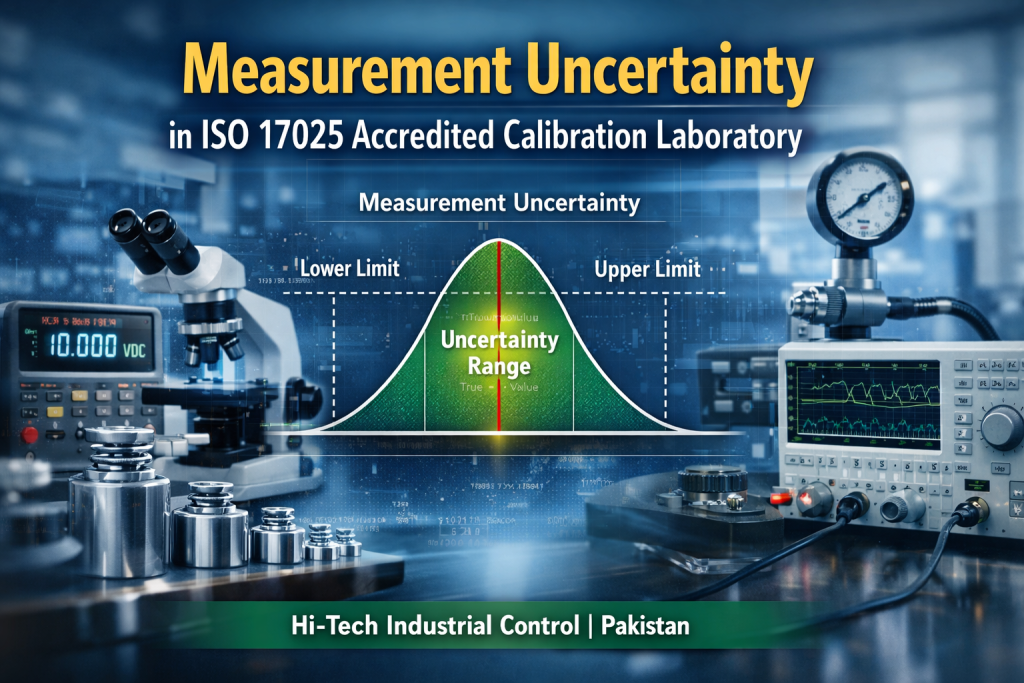
In the world of precision and quality assurance, calibration is not only about comparing an instrument against a reference standard — it is about knowing how reliable that calibration result is. This reliability is expressed through measurement uncertainty, a fundamental requirement of ISO/IEC 17025 accredited calibration laboratories.
For industries where decisions are based on measurement results, understanding uncertainty is not optional — it is essential.
What is Measurement Uncertainty?
Measurement uncertainty is a quantified indication of the quality of a measurement result. It tells us:
- The range within which the true value is expected to lie
- The level of confidence in the reported result
In simple words:
Without uncertainty, a calibration result is incomplete.
ISO/IEC 17025 requires laboratories to evaluate and report uncertainty for all calibrations where it is relevant to the validity or application of the result.
Why Measurement Uncertainty is Important
1. Ensures International Acceptance of Calibration Results
One of the main objectives of ISO/IEC 17025 accreditation is global recognition.
When uncertainty is properly calculated:
- Your results become traceable to SI units
- They are accepted worldwide
- They support international trade and compliance
At Hi-Tech Industrial Control, Pakistan, uncertainty budgets are developed according to international guidelines to ensure globally reliable calibration certificates.
2. Supports Decision Making (Pass/Fail Criteria)
Industries rely on calibration to decide:
- Whether equipment is within tolerance
- Whether production can continue
- Whether a product meets specifications
Without uncertainty, false acceptance or false rejection can occur.
With uncertainty:
✔ Correct conformity decisions are made
✔ Risk is minimized
✔ Product quality is protected
3. Demonstrates Technical Competence
Accreditation bodies do not only check equipment — they evaluate:
- Uncertainty budgets
- Mathematical models
- Type A & Type B evaluations
- CMC (Calibration and Measurement Capability)
A laboratory that properly evaluates uncertainty proves its technical strength and competence.
This is a core strength of Hi-Tech Industrial Control, Pakistan, where uncertainty analysis is integrated into every calibration discipline.
4. Builds Customer Confidence
When a customer receives a calibration certificate with:
- Reported measurement result
- Associated uncertainty
- Stated confidence level
they know:
✅ The lab is technically competent
✅ The result is reliable
✅ The calibration is audit-ready
This builds long-term trust.
5. Required for ISO/IEC 17025 Compliance
Clause 7.6 of ISO/IEC 17025 specifically requires:
- Identification of uncertainty contributors
- Evaluation using appropriate methods
- Reporting where relevant
Without uncertainty evaluation:
❌ Accreditation cannot be achieved
❌ Calibration results lose technical value
Key Contributors to Measurement Uncertainty in Calibration
Some common sources include:
- Reference standard uncertainty
- Resolution of the unit under test
- Repeatability
- Environmental conditions (temperature, humidity, pressure)
- Drift of standards
- Operator influence
A professional laboratory like Hi-Tech Industrial Control, Pakistan carefully studies and quantifies each of these components.
Role of Uncertainty in Calibration and Measurement Capability (CMC)
CMC represents the best measurement capability a laboratory can offer under accreditation.
It is directly based on:
- The smallest achievable uncertainty
- Proven through practical data
- Verified during audits
Lower uncertainty = Higher laboratory capability
Industrial Impact of Proper Uncertainty Evaluation
Industries that benefit include:
- Pharmaceuticals
- Oil & Gas
- Power plants
- Food & beverages
- Textile
- Manufacturing
- Automotive
Accurate uncertainty evaluation leads to:
✔ Reduced production losses
✔ Compliance with regulatory bodies
✔ Improved process accuracy
✔ Better product quality
Why Choose Hi-Tech Industrial Control, Pakistan?
At Hi-Tech Industrial Control, Pakistan, we ensure:
- ISO/IEC 17025 compliant uncertainty evaluation
- Internationally traceable calibration
- Highly reliable calibration certificates
- State-of-the-art standards and methods
- Expert technical team
Our mission is to provide technically sound, audit-ready, and globally accepted calibration services across Pakistan.
Conclusion
Measurement uncertainty is not just a mathematical exercise — it is the foundation of confidence in calibration results.
It:
- Validates measurement quality
- Supports global acceptance
- Protects industrial processes
- Demonstrates laboratory competence
For any organization that values accuracy, compliance, and quality, choosing an ISO/IEC 17025 accredited laboratory with proper uncertainty evaluation — such as Hi-Tech Industrial Control, Pakistan — is a critical business decision.
Looking for ISO/IEC 17025 Accredited Calibration Services in Pakistan?
Hi-Tech Industrial Control, Pakistan is your trusted partner for precise, reliable, and internationally recognized calibration solutions.